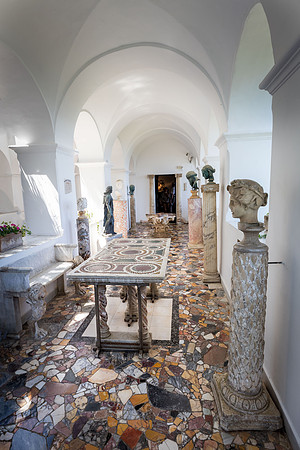
The Villa San Michele was built around the turn of the 20th century on the Isle of Capri, Italy, by the Swedish physician and author Axel Munthe. The villa's gardens have panoramic views of the town of Capri and its harbour, the Sorrentine Peninsula, and Mount Vesuvius. The villa sits on a ledge at the top of the Phoenician Steps, between Anacapri and Capri, at a height of 327 meters above sea level.
San Michele's gardens are adorned with many relics and works of art dating from ancient Egypt and other periods of classical antiquity.
The architecture is there to emphasise the magnificence of the landscape while also creating a romantic-symbolic spirit and a worthy framework for the works of art. In this respect the park also plays an important role. Typical elements include the statues overgrown with ivy and the mossy marble pieces scattered around the garden.
The number of objects in marble, stone, mosaic, and terracotta total about 650. There are about 530 objects in wood, metal, ceramics and textiles. The collections can be divided into several main themes, such as images of nature and animals, as well as death and dying. But they are in no way exhibited pragmatically. Rather, they consist of apparently haphazardly assembled pieces of widely differing quality.
Regardless of an individual object’s artistic quality, what was important to Axel Munthe was the message it conveyed or the personal memories it evoked for him.
A spectacular pergola path overlooking the entire Bay of Naples leads from the villa to the famous Sphinx Parapet, where an ancient Egyptian sphinx looks out toward Sorrento: you cannot see its face—on purpose. It is said that if you touch the sphinx's hindquarters with your left hand while making a wish, it will come true.