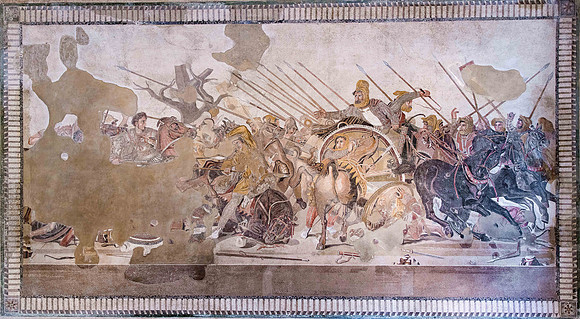
Battle of Issus between Alexander and Darius III. The mosaic, the largest in the House of the Faun in Pompeii, made with the use of about one million tesserae, depicts the battle of Issus fought between Alexander the Great and Darius III in 333 BC; it marked the end of the Persian Empire.
The mosaic, on the left side, shows Alexander who, astride his horse Bucephalus, leads his men against the fleeing Persians. Opposite Alexander towers the figure of Darius on his retreating war chariot. Between the two is a Persian prince who displays his loyalty by using his body to shield his king, while a soldier offers him his own horse, thus condemning himself to certain death.
The use of opus vermiculatum (a technique of mosaic which uses very small tesserae) enabled the craftsman to render all the effects of luminosity, the changes in color, the details of the armour and the faces, and even the moods.
This mosaic has the historical distinction of being the only known depiction still existing of Alexander that was taken from life. The mosaic was copied from an ancient painting made of Alexander while he was still alive that has been lost.