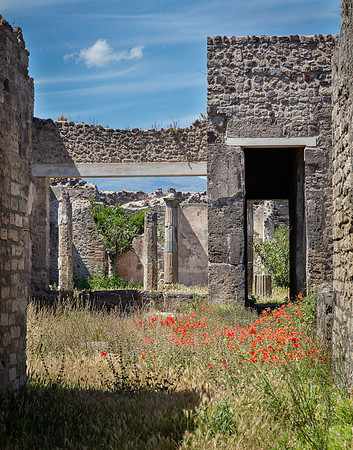
Pompeii was an ancient Roman town-city near modern Naples. Pompeii, along with Herculaneum and many villas in the surrounding area, was mostly destroyed and buried under 13 to 20 feet of volcanic ash and pumice in the eruption of Mount Vesuvius in AD 79.
Researchers believe that the town was founded in the 7th or 6th century BC. It came under the domination of Rome in the 4th century BC, and was conquered and became a Roman colony in 80 BC after it joined an unsuccessful rebellion against the Roman Republic. By the time of its destruction, 160 years later, its population was estimated at 11,000 people, and the city had a complex water system, an amphitheatre, a gymnasium, and a port.
The eruption destroyed the city, killing its inhabitants and burying it under tons of ash. Evidence for the destruction originally came from a surviving letter by Pliny the Younger, who saw the eruption from a distance and described the death of his uncle Pliny the Elder, an admiral of the Roman fleet, who tried to rescue citizens. The site was lost for about 1,500 years until its initial rediscovery in 1599 and broader rediscovery almost 150 years later. The objects that lay beneath the city have been preserved for more than a millennium because of the long lack of air and moisture. These artifacts provide an extraordinarily detailed insight into the life of a city. During the excavation, plaster was used to fill in the voids in the ash layers that once held human bodies. This allowed archaeologists to see the exact position the person was in when he or she died.
Archaeologists have found a complete city almost entirely intact—loaves of bread still sat in the oven, bodies of men, women, children, and pets were found frozen in their last moments, the expressions of fear still etched on their faces, and the remains of meals remained discarded on the pavement. The astounding discovery meant that researchers could piece together exactly what life was like for the ancient Romans of Pompe