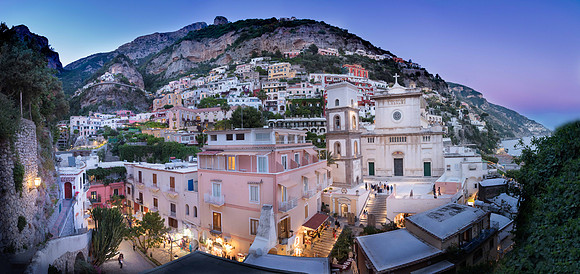
The colorful ceramic tiled dome of the Church of Santa Maria Assunta (Chiesa di Santa Maria Assunta) shows up in many Positano photographs—the church's position near the waterfront at the bottom of a cascading hill of pastel houses makes it especially photogenic. While there has been a church at this site since medieval times, the current building dates from around 1800.
The dome's majolica tiles get much of the attention from the outside, but a visit inside reveals a series of grand archways, elaborate classical decor, and the church's star attraction: a 12th-century Byzantine icon of a Black Madonna and Child. Its said that the icon was on a ship passing near present-day Positano when the sailors on board heard someone (this was believed to be the icon) saying, “Posa! Posa!” (Put me down!). The icon has been in Positano ever since and that story is also how the town got its name.
Today, the church serves the local people plus it is
a popular spot for exchanging vows. Beneath the church
are the ruins of a Roman villa dating back to the 2nd century BC—the ruins were discovered during a renovation of the site's medieval crypt.