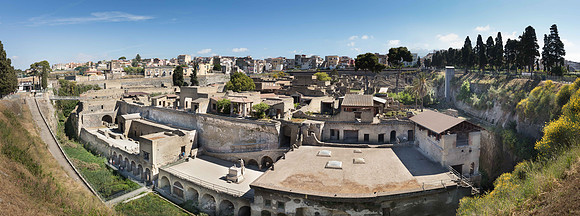
Herculaneum is a superbly conserved Roman fishing town that had about 4,000 inhabitants. It's fate runs parallel to that of Pompeii. Destroyed by an earthquake in AD 62, the AD 79 eruption of Mt Vesuvius saw it submerged in a 50 foot-thick sea of mud that essentially fossilised the city. This meant that even delicate items, such as furniture and clothing, were discovered remarkably well preserved. Tragically, the inhabitants didn't fare so well; thousands of people tried to escape by boat but were suffocated by the volcano's poisonous gases. Indeed, what appears to be a moat around the town is in fact the ancient shoreline. It was here in 1980 that archaeologists discovered some 300 skeletons inside the arched openings at the bottom left of this photo, the remains of a crowd that had fled to the beach only to be overcome by the terrible heat of clouds surging down from Vesuvius.