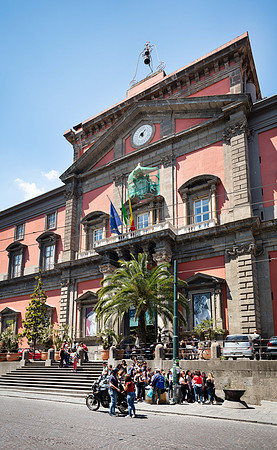
Naples' National Archaeological Museum serves up one of the world’s finest collections of Graeco-Roman artefacts. Originally a cavalry barracks and later seat of the city’s university, the museum was established by the Bourbon king Charles VII in the late 18th century to house the antiquities he inherited from his mother, Elisabetta Farnese, as well as treasures looted from Pompeii and Herculaneum. Star exhibits include the celebrated Toro Farnese (Farnese Bull) sculpture and a series of awe-inspiring mosaics from Pompeii.
Of the mosaics taken from the House of the dancing Faun, The Battle of Alexander against Darius really stands out. The best-known depiction of Alexander the Great, the 20-sq-metre mosaic was probably made by Alexandrian craftsmen working in Italy around the end of the 2nd century BC.
Beyond the mosaics, the Gabinetto Segreto (Secret Chamber) contains a small but much-studied collection of ancient erotica. Pan is caught in the act with a nanny goat in the collection’s most famous piece – a small and surprisingly sophisticated statue taken from the Villa dei Papiri in Herculaneum. You'll also find a series of nine paintings depicting erotic positions – a menu for brothel patrons.
Originally the royal library, the enormous Sala Meridiana (Great Hall of the Sundial) on the 1st floor is home to the Farnese Atlante, a statue of Atlas carrying a globe on his shoulders.