The Church of Gesù Nuovo was originally a palace built in 1470 for Roberto Sanseverino, Prince of Salerno. Political intrigues by the Sanseverino family caused the property to be confiscated, and eventually sold in the 1580s to the Jesuits for 45,000 ducats to construct a church (1584–1601) under architect Giuseppe Valeriano. Construction of the church began in 1584. The new church retained the unusual facade, originally built for the palace, faced with rustic ashlar diamond projections.
When the Jesuits were expelled from Naples in 1767, the church passed to the Franciscan order. The Jesuits returned in 1821, only to be expelled again in 1848.
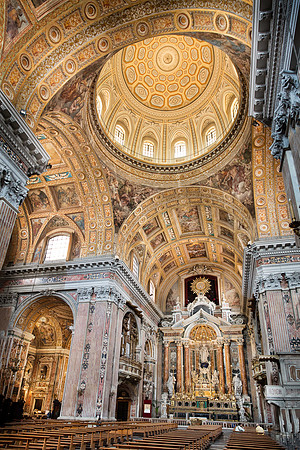
The vault frescos, representing biblical and saintly narratives that exalt the name of Jesus, were carried out by Belisario Corenzio and Paolo de Matteis. At the back of the facade is The Expulsion of Heliodorus from the Temple (1725), a baroque masterpiece by Francesco Solimena. On the four pillars which support the dome are frescos of the four Evangelists, carried out by Giovanni Lanfranco. The inside of the dome had also been decorated by Lanfranco, but this was destroyed in the earthquake of 1688. Paolo de Matteis then repainted a new dome. The frescos of the life of the Virgin, placed on the second part of the vault up to the apse, are by Massimo Stanzione.
Surrounding the altar are three bronze bas-reliefs on a black marble base: on the left, The Supper at Emmaus (by Salvatore Irdi), on the right, The Promise of the Eucharist at Capernaum, and in the middle a reproduction of the Last Supper by Leonardo da Vinci. These last two bas-reliefs are by Gennaro Calì.
Above the altar, with didactic and historical symbols concerning the mystery of the Eucharist, are eight busts of saints who glorified the Eucharist.